Losing air pressure on the highway? How to tell a leak from a compressor failure, why the spring brakes lock, and what a mobile mechanic fixes roadside.
Air brakes fail safe — that’s the design. When system pressure drops far enough, the spring brakes clamp on and the truck stops moving, whether you like where it’s parked or not. It’s the right engineering trade, and it’s also why a “small air leak” on I-40 can end with a rig locked solid on a shoulder fifty miles from the nearest shop.
Here’s how to read what your air system is telling you, how to tell a leak from a compressor problem, and what can actually be fixed where the truck sits.
The Gauges Tell the Story First
You’ve got two air gauges and a low-pressure warning for a reason. What they do under way is the first diagnostic:
- Slow bleed while driving, compressor keeping up at speed — you likely have a leak the compressor can outrun at highway RPM but not at idle. Classic pattern: pressure fine on the road, dropping at every stop.
- Steady drop no matter what the engine’s doing — either a serious leak or a compressor that isn’t building air. If the needles fall with the engine running hard, treat it as urgent.
- One tank falling, the other holding — the dual-circuit system is doing its job isolating a failure. Note which circuit, primary or secondary; it narrows the search enormously.
- Low-pressure warning on — you’re on borrowed time. Find your stopping point now, because the springs will choose one for you soon.
And a habit worth keeping: the leak-down check in your pre-trip isn’t ceremony. A system that barely passed this morning is telling you where today’s problem will be.
Leak vs. Compressor: How to Tell Roadside
Leaks are the everyday failure — chafed lines, failed fittings, dried O-rings, leaking chambers, valves that won’t hold. With the engine off and system charged, a big leak is often audible: a steady hiss near the tanks, under the cab, or back at a chamber. Note where the sound is; don’t crawl into the traffic side to chase it.
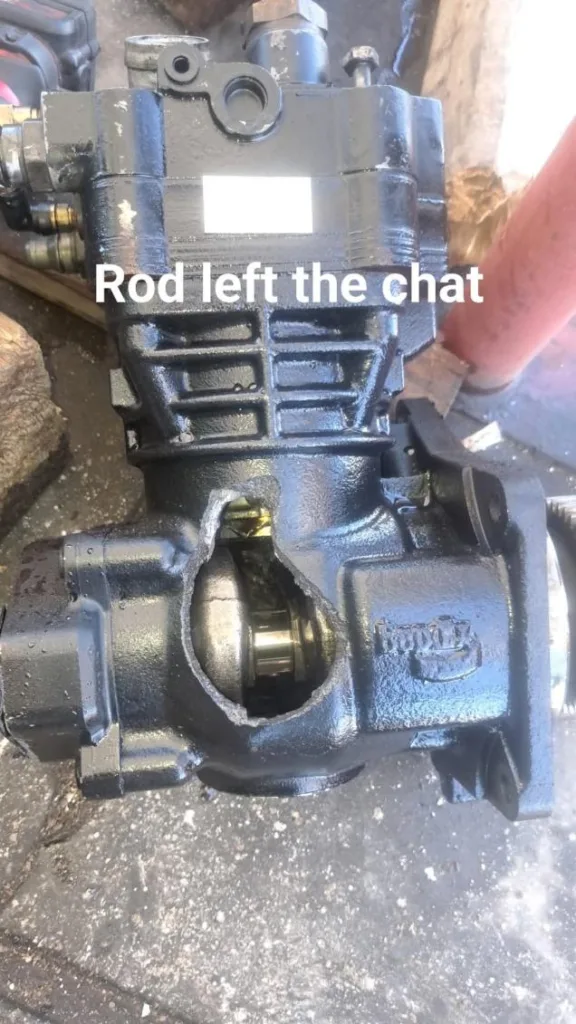
Compressor failures are less common and more serious. If the engine is running and pressure just won’t build — or builds painfully slowly with no hiss anywhere — the compressor, its unloader, or the governor is suspect. Compressors can also fail dramatically; we’ve replaced units that let go hard enough to hole the housing.
One more suspect on this corridor: heat and rubber don’t get along. Desert temperatures age air lines, seals, and chamber diaphragms faster than the calendar says they should. A line that would have lasted another year in a mild climate cracks out here in August.
About Caging Brakes — Read This Before You Try
When the springs lock a truck, the standard way to move it is caging: threading the caging bolt into each spring brake chamber to mechanically compress the spring. Every driver has heard of it; forums are full of drivers doing it on the shoulder.
Understand what you’re working with before you copy them. A spring brake chamber holds a massive compressed spring, and the ones that strand trucks out here are often the same ones with years of corrosion on the housing. A corroded chamber can let go while it’s being caged, and the energy in that spring is enough to maim. This is genuinely a job for someone who does it weekly, with the right tools, who can also judge whether the chamber is safe to touch at all.
There’s also no prize for caging a truck that could have been repaired where it sat. Caging doesn’t fix anything — it just makes the truck movable. A mobile mechanic can usually fix the actual failure, which is the difference between driving away and paying for a tow you didn’t need.
What Mobile Air Brake Repair Covers
Most air-system failures are roadside-repairable, and it’s core work for mobile truck air brake repair on this route:
- leak tracing and line, fitting, and valve replacement
- brake chamber replacement — done safely, corroded or not
- compressor, governor, and unloader diagnosis and replacement
- slack adjuster and foundation-brake issues found during the repair
- system-wide checks with dealer-level diagnostics where electronic controls are involved
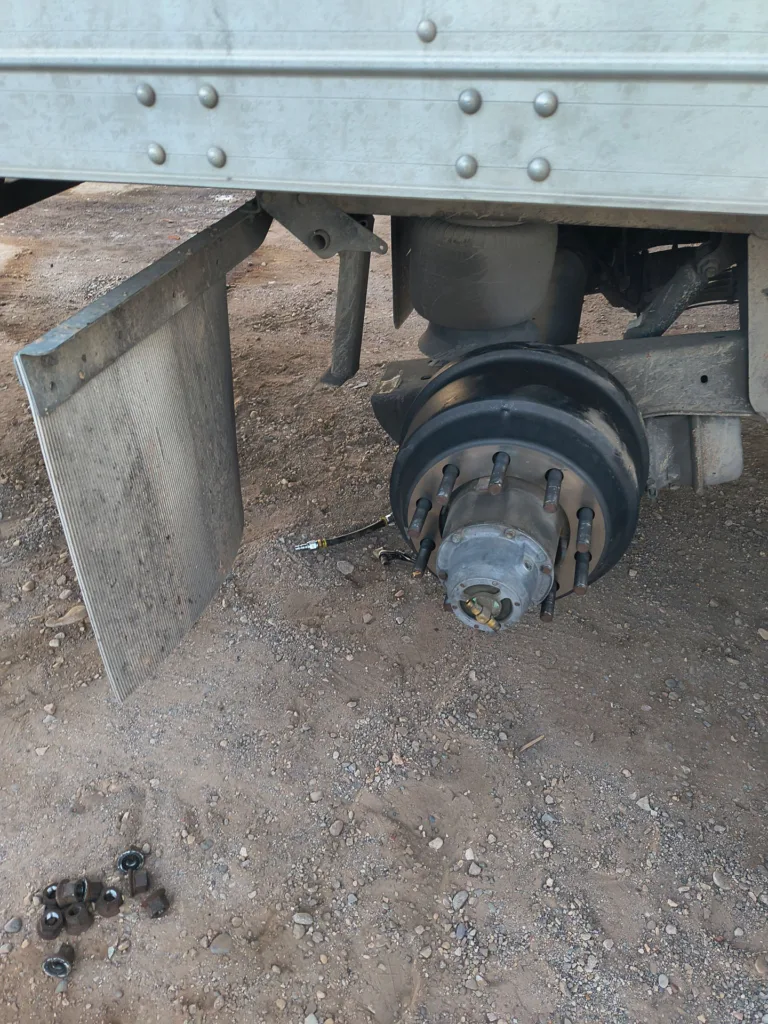
Worth saying plainly: brakes are the one system where inspection consequences are severe. Air-system defects are out-of-service material under CVSA criteria, and I-40 has commercial enforcement on both sides of the river. The move isn’t to nurse a leak past the scales — it’s to fix it properly, roadside, before the inspection finds it for you. The full corridor is normal working territory for mobile diesel repair, so the fix comes to you.
What to Tell Dispatch
- Location — direction, mile marker or exit, which side of the highway.
- What the gauges did — which circuit, how fast the drop, warning light or full spring-brake lockdown.
- What you can hear — hiss location if you found one safely, or “no hiss, won’t build.”
- Whether the truck is drivable or locked — it changes what comes on the service truck.
- Load status — loaded trailer, reefer, hazmat, and any delivery clock.
Frequently Asked Questions
Quick answers for the questions homeowners ask before they call or book.
My pressure only drops when I’m stopped. Can I keep driving to a shop?
That’s the compressor outrunning a leak, and it’s a gamble — leaks grow, and the springs don’t negotiate. Getting it repaired where you next stop safely beats finding out mid-grade that it got worse.
The spring brakes locked. Do I need a tow now?
Usually not. If the underlying failure is repairable roadside — and most are — the truck drives away without ever being caged or towed. That’s the first thing to establish on the phone.
Can you tell a leak from a compressor failure over the phone?
Often close to it, from exactly the observations above. On-site, gauges, listening, and diagnostics settle it quickly.
Is this really a 24/7 thing?
Yes. Air systems fail at 2 a.m. exactly as often as they fail at 2 p.m., and night calls on I-40 are routine.
Losing Air Right Now?
Pick your stopping point while you still can, note the mile marker, and call TRT Road Service at (928) 577-1496 — 24/7 mobile air brake repair on the I-40 and AZ-95 corridors. Anything non-urgent can go through the contact page.
TRT Road Service