What dealer-level JPRO diagnostics actually show a roadside mechanic — SPN/FMI fault data, live sensors, forced regens — and why it beats a generic reader.
Every truck stop parking lot has a guy with a code reader. Plug in, pull a number, look it up on a phone, start guessing. Sometimes that works. On a modern emissions-era diesel, a long way from a shop, it’s usually the first step of an expensive guessing game.
The difference between that and dealer-level diagnostics is the difference between knowing something is wrong and knowing what to fix. Here’s what JPRO — the diagnostic platform TRT runs on every service call — actually shows a roadside mechanic, and why it changes what’s fixable on the shoulder.
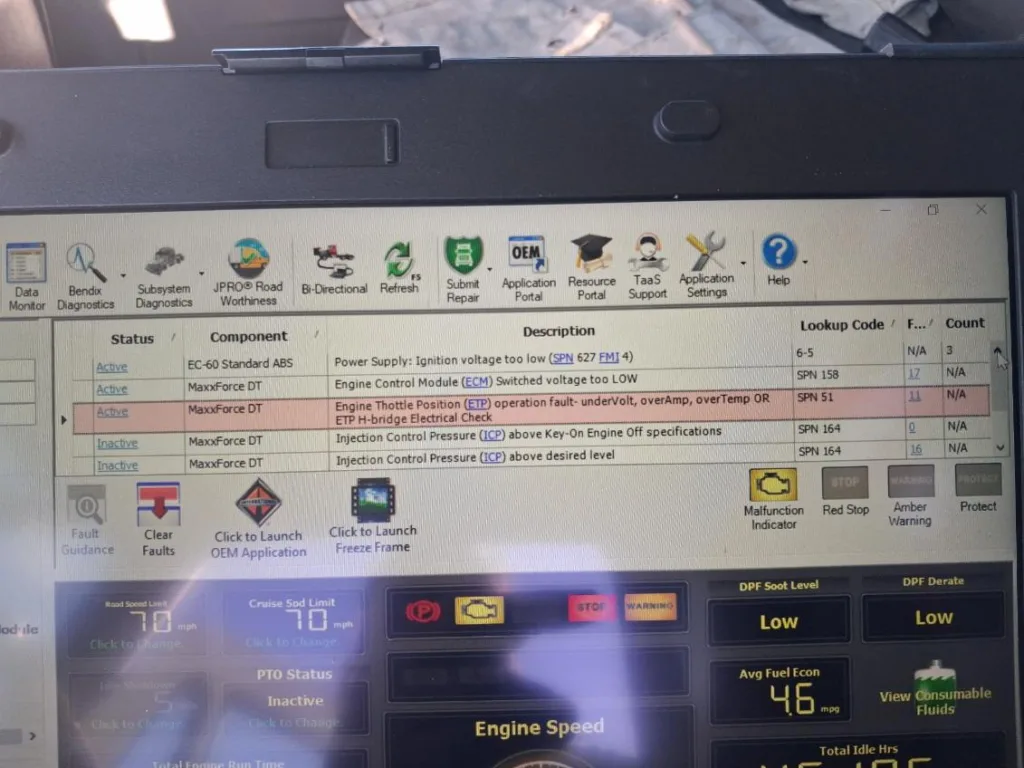
The Language Your Truck Actually Speaks
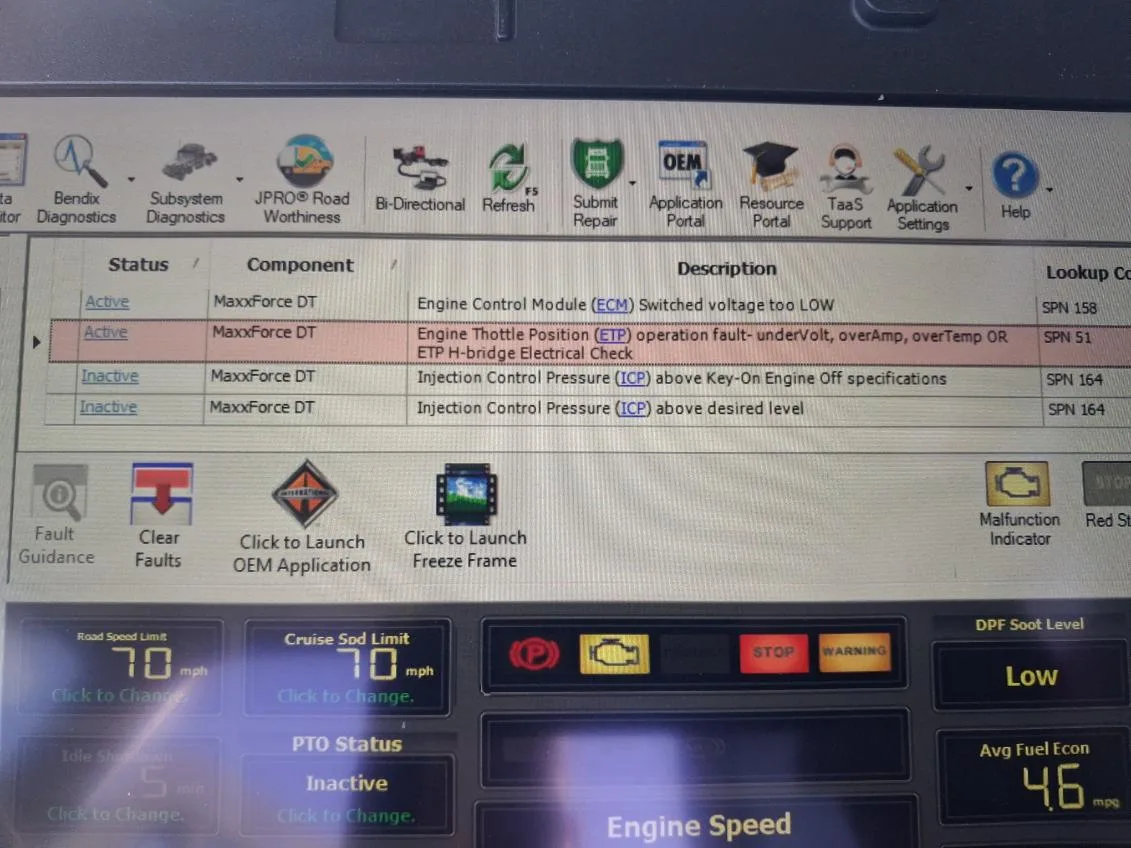
Heavy trucks don’t talk in the simple codes a generic OBD reader shows. They report faults as SPN/FMI pairs — the SPN naming the exact component or signal, the FMI describing how it’s failing: voltage too high, signal erratic, data out of range, circuit shorted.
That second half is the part cheap readers throw away, and it’s the part that matters. Take a battery-voltage fault like SPN 158: “voltage low” and “voltage intermittent” are the same code family but completely different repairs — one points at a dying battery bank, the other at a chafed cable or corroded ground that only fails on bumps. A reader that just says “electrical fault” leaves the mechanic guessing between a battery swap and a wiring hunt. The full SPN/FMI data settles it before a wrench comes out.
Multiply that across every system on the truck — engine, aftertreatment, transmission, ABS, body controllers — and you get the real picture: dealer-level tools see the whole vehicle, in the manufacturer’s own vocabulary, across essentially every make that runs these corridors.
Live Data: Watching the Failure Happen
Stored codes tell you what tripped. Live data tells you what’s happening right now — and roadside, that’s often the whole diagnosis:
- Charging system — actual alternator output under load, not a guess from a dim headlight
- Fuel and air — pressures and temperatures that separate “filter plugging” from “pump dying”
- Aftertreatment — soot load, DEF dosing behavior, exhaust temps; the difference between a filter that needs a regen and one that needs replacement
- Cooling — real coolant temps and fan commands while the engine idles, catching the thermostat or fan clutch in the act
A parked truck with a laptop on the engine bus can be tested, not just inspected. That’s the practical difference.
Commands a Code Reader Simply Doesn't Have
The biggest gap isn’t reading — it’s doing. Dealer-level software sends commands, and several of them are exactly the ones that get stranded trucks moving:
- Forced DPF regeneration — the classic. A soot-loaded filter that’s put the engine in derate can often be regenerated on-site in an hour instead of towed to a shop. It’s one of the most common wins on the DPF and DEF system side of the business.
- Bi-directional component tests — command a fan on, cycle a valve, fire an injector, run a dosing pump. Instead of inferring which part failed, you tell it to work and watch whether it does.
- Reset and relearn routines — after the physical repair, the systems that need to be told about it get told, properly, so the truck doesn’t derate again at the next on-ramp over a stale fault.
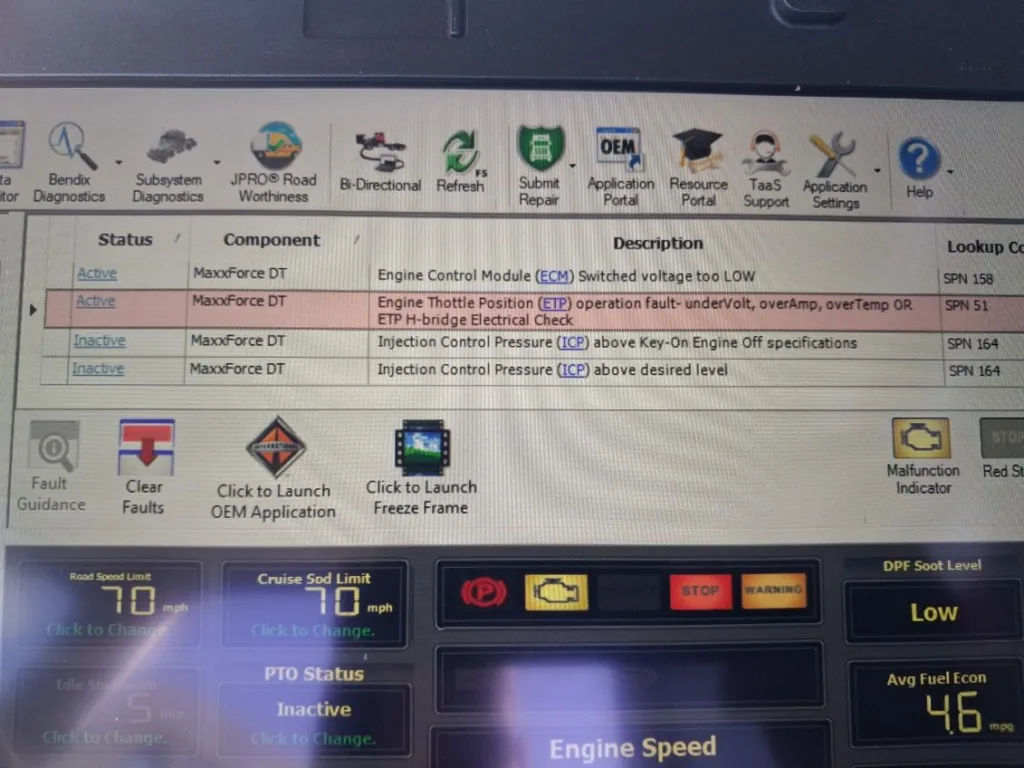
Why This Matters More on Remote Highway
In a city, a wrong first guess costs an hour. On the empty stretches of the I-40 corridor or down the AZ-95 river route, a wrong guess costs a second service trip, a day of downtime, or a tow that was never necessary. Root-cause-first diagnosis is worth the most precisely where you are when you need it — the heavy-duty diagnostics page covers the service itself.
It also keeps the honesty in the triage. When the data says a failure is beyond roadside repair — internal engine damage, a component that needs a shop crane — you find that out during diagnosis, before the tow decision, not after paying for both.
What This Looks Like on a Real Call
A derated truck near Kingman calls in. On arrival, the laptop goes on the truck before the tools come out: stored SPN/FMI faults pulled, live aftertreatment data checked, soot load read. If it’s regen-appropriate, a forced regen runs on-site and the driver watches the derate clear. If a sensor or dosing component is the real culprit, the bi-directional tests confirm exactly which one — and the mobile repair that follows fixes that, once, instead of replacing parts until the light goes out.
That workflow is the same at a rest stop at 2 a.m. as it is in a truck stop lot at noon. Dispatch is 24/7, and diagnostics ride on every truck.
Frequently Asked Questions
Quick answers for the questions homeowners ask before they call or book.
Is JPRO really different from the scanner a truck stop shop uses?
It’s dealer-level: full SPN/FMI fault detail, live data, and bi-directional commands across makes. Generic readers show a subset of codes with none of the command capability — enough to name a symptom, rarely enough to fix a cause.
Can you diagnose before dispatching?
Partly — the dash message, warning behavior, and your description narrow it substantially on the phone. The on-site hookup confirms root cause before parts decisions get made.
Does a diagnosis commit me to the repair?
It commits you to knowing what’s wrong. What to do about it — repair now, defer, or shop referral for the genuinely shop-bound — is a conversation you have with real information instead of a guess.
Which trucks can you connect to?
The makes and engine families that run these corridors — Cummins, Detroit, PACCAR, Volvo, International/MaxxForce among them. Tell dispatch the truck and engine when you call.
Warning Light On Right Now?
Take a photo of the dash, note your mile marker, and call TRT Road Service at (928) 577-1496 — 24/7 mobile diagnostics and repair on the I-40 and AZ-95 corridors. Non-urgent questions go through the contact page.
TRT Road Service